What the blockchain operating system actually is
The NEAR Blockchain Operating System (BOS) is not a new token, a separate network, or a frontend wrapper. It is the core infrastructure layer that connects users, AI agents, and underlying blockchains. By standardizing how applications are discovered, deployed, and interacted with, BOS turns NEAR into the execution layer for AI-native apps, enabling agents to own assets, make decisions, and transact freely across networks.
Think of BOS as the interface between human intent and machine execution. In traditional software, an operating system manages hardware resources so applications can run. In the NEAR ecosystem, BOS manages blockchain resources so agents and users can interact with decentralized applications (dApps) without needing to understand the underlying complexity. It provides a common layer for browsing, deploying, and interacting with smart contracts, effectively abstracting away the friction of wallet connections, gas fees, and cross-chain bridging.
This infrastructure shift is critical for the 2026 market landscape because it lowers the barrier to entry for both developers and users. Developers can build once and deploy across the NEAR ecosystem, while users can interact with any BOS-enabled app through a unified interface. This standardization creates a network effect, making NEAR the preferred platform for AI agents that require reliable, low-latency execution and asset ownership.
The BOS is an industry-first category: a common layer for browsing and interacting with blockchain applications. It allows AI agents to autonomously discover and execute transactions, a capability that traditional blockchains struggle to support due to their rigid, user-centric designs. By treating the blockchain as an operating system, NEAR positions itself as the foundational infrastructure for the next generation of decentralized AI.
The three pillars of NEAR infrastructure
NEAR’s architecture relies on three distinct layers working in concert: dynamic sharding for the base layer, Aurora for EVM compatibility, and the Blockchain Operating System (BOS) for composability. Together, they form a stack designed to handle high-throughput agent transactions without sacrificing decentralization or security.
Nightshade sharding
NEAR’s Nightshade protocol implements dynamic sharding, splitting the network into multiple shards that process transactions in parallel. Unlike static sharding solutions, Nightshade adjusts shard assignments based on network load, ensuring consistent throughput even during peak demand. This mechanism allows NEAR to scale horizontally, processing thousands of transactions per second while maintaining finality in seconds. It is the engine that prevents the network from becoming a bottleneck for agent-driven activity.
Aurora EVM integration
Aurora is an EVM-compatible layer built on NEAR, bridging the gap between NEAR’s high-performance environment and the Ethereum ecosystem. By running on NEAR, Aurora inherits its sharding capabilities, offering significantly lower gas fees and faster block times than Ethereum mainnet. This integration allows developers to deploy Solidity contracts without rewriting code, while benefiting from NEAR’s underlying infrastructure. For crypto agents, Aurora provides a familiar development surface with the scalability needed for high-frequency interactions.
The Blockchain Operating System (BOS)
The BOS is NEAR’s unique layer that enables composable, user-centric applications. It treats accounts as modular entities, allowing developers to stack functionalities like wallets, social profiles, and agent interfaces into a single account. This modularity reduces friction for users and agents alike, as interactions can be composed from pre-built components rather than built from scratch. The BOS effectively turns the blockchain into an operating system where agents and users interact seamlessly.
| Feature | NEAR (Nightshade) | Traditional L1 (e.g., ETH 1.0) |
|---|---|---|
| Scaling Method | Dynamic Sharding | Layer 2 Rollups / Sidechains |
| Transaction Throughput | High (Parallel Processing) | Low (Sequential Processing) |
| EVM Compatibility | Via Aurora (Native) | Native (but constrained) |
| Finality Time | Seconds | Minutes to Hours |
Why agents need this specific stack
The narrative around AI agents often stalls at the "agentic loop"—the cycle of perception, planning, and action. But an agent is only as useful as its ability to act on the real world. For AI to move beyond generating text and into executing transactions, it needs a financial layer that is programmable, fast, and secure. This is where NEAR BOS (Blockchain Operating System) steps in, positioning NEAR not just as a blockchain, but as the currency of agents.
NEAR provides the execution layer for AI-native applications. It enables agents to own assets, make autonomous decisions, and transact freely across networks. Without this infrastructure, agents remain isolated within silos, unable to interact with decentralized finance, NFTs, or other on-chain services. BOS changes this by providing a secure harness that allows agents to operate with a level of autonomy previously reserved for human operators.
"NEAR is the execution layer for AI-native apps — enabling agents to own assets, make decisions, and transact freely across networks."
This capability is critical for the next wave of AI adoption. When an agent can hold a wallet, it can pay for API calls, buy data, or transfer value without human intervention. This turns AI from a passive tool into an active economic participant. The infrastructure supports cross-chain execution and confidential settlement, ensuring that these transactions are both versatile and private.
The combination of private inference and secure agent harnesses means that sensitive data can be processed without exposing it to the public chain. This is essential for enterprise agents handling proprietary information. By keeping the inference private and the settlement secure, NEAR BOS offers a balanced environment where AI can operate at scale without compromising security.


As an Amazon Associate, we may earn from qualifying purchases.
Key tools for NEAR market research
Evaluating the health of the NEAR BOS ecosystem requires moving beyond surface-level price action. You need infrastructure that tracks on-chain activity, smart contract deployments, and user engagement across the decentralized web. These tools provide the concrete data needed to assess whether the network is growing organically or relying on temporary incentives.
Start with NEAR Explorer (explorer.near.org). It is the primary interface for verifying transaction validity, inspecting smart contract state, and monitoring account balances. For developers and analysts, it offers the granular visibility required to audit BOS-specific deployments and verify that protocol upgrades are functioning as intended.
For broader network health, NEAR Data Hub (datahub.near.org) aggregates historical data into queryable datasets. This resource is essential for backtesting strategies and identifying long-term trends in block production, shard performance, and validator distribution without relying on third-party proxies.
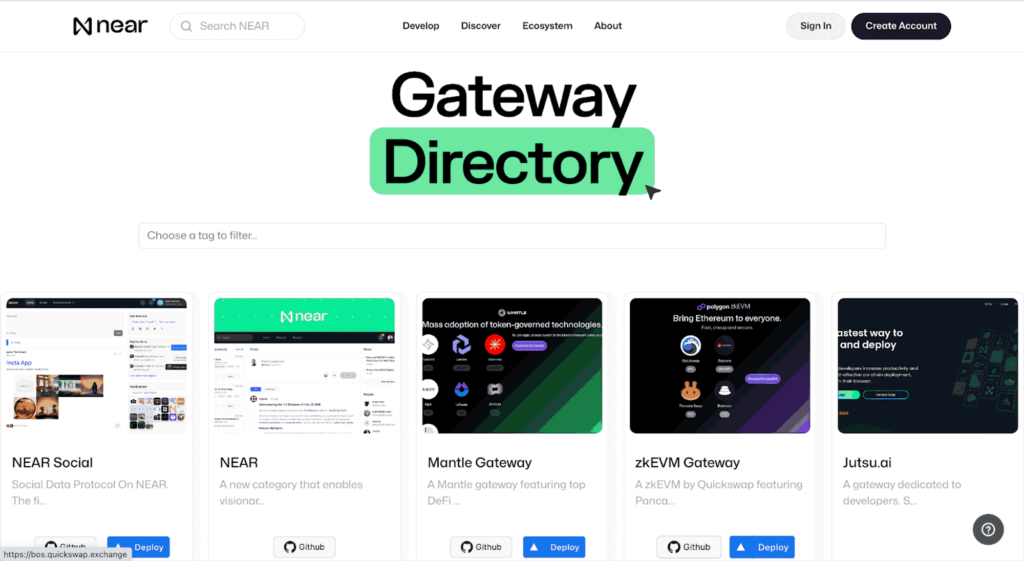
To understand the BOS layer specifically, monitor NEAR Social (near.social). This is the primary gateway for Open Web applications on NEAR, serving as both a user interface and a data source for social graph activity. Tracking engagement here helps gauge the real-world utility of BOS-based front-ends beyond mere token speculation.
Finally, leverage NEAR Analytics (nearanalytics.com) for visualized metrics on active addresses, transaction volume, and staking ratios. These dashboards consolidate complex on-chain events into digestible charts, allowing you to quickly identify shifts in market sentiment or network congestion.
Strategic Risks in the Agent Economy
The NEAR BOS ecosystem offers powerful tools for autonomous agents, but investors must navigate two distinct categories of risk: regulatory ambiguity and technical dependency. These factors define the boundary between speculative potential and operational reality.
Regulatory frameworks for AI agents operating on-chain remain undefined. Unlike traditional financial transactions, autonomous code execution blurs the lines of liability. If an agent executes a harmful or non-compliant action, determining responsibility is complex. NEAR’s architecture supports this through confidential settlement and private inference, allowing sensitive data to remain protected while maintaining transparency for audit trails. However, the lack of clear global standards means projects must build compliance into their code from day one.
Technical dependencies introduce another layer of fragility. Agents rely heavily on external data feeds, oracle services, and cross-chain bridges. A failure in any of these upstream components can halt agent operations or expose users to exploits. The NEAR ecosystem mitigates some of this by integrating cross-chain execution and a secure agent harness, but the reliance on third-party infrastructure remains a vulnerability.
Investors should scrutinize how individual projects handle these risks. Look for agents that utilize NEAR’s native security features, such as confidential computing, to protect user data and ensure that their operational logic is transparent and auditable. The infrastructure is robust, but the regulatory landscape is not yet settled.
No comments yet. Be the first to share your thoughts!