What is the NEAR BOS architecture
Use this section to make the NEAR BOS Crypto Infrastructure decision easier to compare in real life, not just on paper. Start with the reader's actual constraint, then separate must-have requirements from details that are merely nice to have. A practical choice should survive normal use, maintenance, timing, and budget. If a recommendation only works in an ideal situation, call that out plainly and give the reader a fallback path.
The simplest way to use this section is to write down the must-have criteria first, then compare each option against those criteria before weighing nice-to-have features.
How agents use NEAR for cross-chain execution
Agents need to move value and data across different blockchains to function effectively. Traditional cross-chain methods often rely on complex, centralized bridges that introduce security risks and high latency. NEAR solves this through its intent-based architecture, which allows agents to specify what they want to achieve rather than managing the underlying transaction mechanics.
NEAR Intents act as a declarative layer. An agent declares a goal, such as "swap Token A on Chain X for Token B on Chain Y." The network's intent solvers then find the most efficient path to execute that goal across multiple chains. This abstraction removes the need for agents to understand or manage the intricate details of each specific chain's protocol.
This approach enables seamless cross-chain execution without the friction of traditional bridging. Agents can interact with liquidity pools, execute trades, or settle data on different networks as if they were on a single unified chain. The result is a more robust and efficient agent economy where infrastructure handles the complexity.
| Feature | Traditional Bridging | NEAR Intents |
|---|---|---|
| Execution Model | Centralized lock/mint | Declarative intent solving |
| Security Risk | High (bridge exploits) | Lower (distributed solvers) |
| Agent Complexity | High (manual routing) | Low (goal-oriented) |
| Cross-Chain Scope | Limited pairs | Multi-chain interoperability |
The NEAR Protocol provides the underlying infrastructure for this system. Its fully sharded design and high throughput support the rapid execution required by autonomous agents. By combining cross-chain execution with confidential settlement and private inference, NEAR creates a secure environment for agent-driven economies.
Private inference and confidential settlement
Enterprise AI agents cannot operate on the blockchain with their logic exposed. If a trading bot or a medical diagnostic agent reveals its algorithm or the data it processes, competitors can copy the strategy and users lose privacy. NEAR addresses this by combining private inference with confidential settlement, creating a secure layer for high-stakes agent interactions.
Private inference allows agents to process sensitive inputs—such as proprietary financial models or personal health records—without exposing the raw data or the computation results to the public chain. This is not just encryption; it ensures that the agent's decision-making process remains opaque to external observers while still being verifiable. For the agent economy, this is the difference between a public billboard and a secure vault. Agents can now handle enterprise-grade data without leaking trade secrets or violating compliance standards like HIPAA or GDPR.
Confidential settlement complements this by ensuring that the final state changes and asset transfers remain hidden until they are finalized. While the existence of a transaction might be public, the specifics of who is transferring what, and under what complex conditions, are kept within a secure enclave. This prevents front-running and ensures that agent-to-agent negotiations happen on fair, transparent terms without exposing vulnerable strategies to arbitrage bots.
This infrastructure transforms NEAR from a simple execution layer into a trusted environment for autonomous economic activity. By securing both the inference (the thinking) and the settlement (the action), NEAR enables agents to operate with the confidentiality required for real-world business, moving beyond speculative trading into legitimate, high-value automation.
NEAR tokenomics and revenue capture
Use this section to make the NEAR BOS Crypto Infrastructure decision easier to compare in real life, not just on paper. Start with the reader's actual constraint, then separate must-have requirements from details that are merely nice to have. A practical choice should survive normal use, maintenance, timing, and budget. If a recommendation only works in an ideal situation, call that out plainly and give the reader a fallback path.
The simplest way to use this section is to write down the must-have criteria first, then compare each option against those criteria before weighing nice-to-have features.
Building on the NEAR stack in 2026
NEAR BOS Crypto Infrastructure works best as a clear sequence: define the constraint, compare the realistic options, test the tradeoff, and choose the path with the fewest hidden costs. That order keeps the advice usable instead of decorative. After each step, pause long enough to check whether the recommendation still fits the reader's actual situation. If it depends on perfect timing, unusual access, or a best-case budget, include a simpler fallback.

Common questions about NEAR BOS
NEAR Protocol functions as a fully sharded, Layer-1 blockchain built for high-performance decentralized applications. It utilizes Nightshade sharding to maintain 100% mainnet uptime while supporting up to one million transactions per second with 600ms block times and 1.2-second finality.
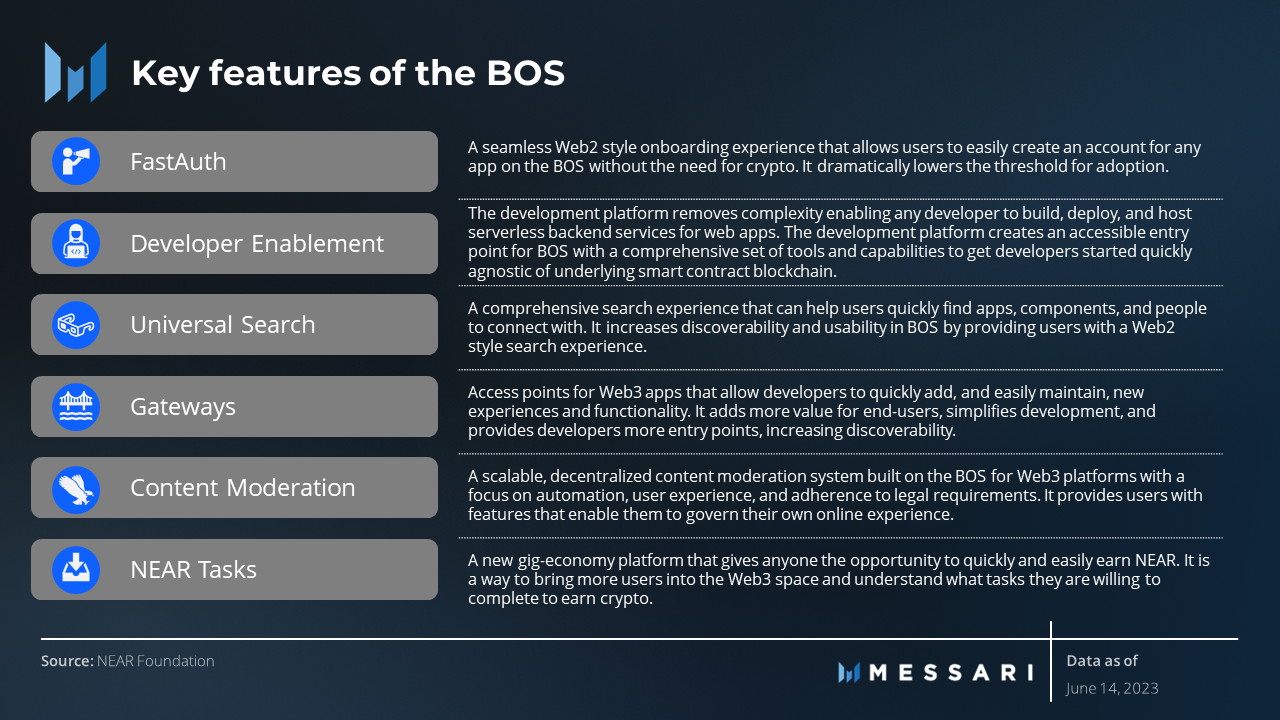
The Blockchain Operating System (BOS) is the infrastructure layer that allows developers to create, deploy, and store secure, decentralized front-end applications. It acts as a modular framework, enabling seamless integration of various blockchain protocols and networks into a unified agent economy.
No comments yet. Be the first to share your thoughts!