What is the NEAR Blockchain Operating System?
The NEAR Blockchain Operating System (BOS) is a distinct category of infrastructure designed to solve the fragmentation problem in Web3. Rather than just being another Layer-1 blockchain, the BOS acts as a common layer for browsing and discovering open web experiences. It allows developers to compose frontends that can interact with any blockchain, effectively decoupling the user interface from the underlying consensus mechanisms.
Think of the BOS as the "desktop environment" for the decentralized web. Just as Windows or macOS provides a unified interface for running diverse applications regardless of the hardware beneath, the BOS provides a standardized way to navigate and interact with decentralized applications (dApps) across multiple networks. This approach simplifies development by allowing teams to build once and deploy across various chains, while giving users a seamless experience without needing to manage multiple wallets or bridge assets manually for every interaction.
This infrastructure-first strategy distinguishes NEAR from competitors that focus primarily on throughput or specific verticals. By treating the frontend composition layer as a core utility, NEAR aims to reduce the friction that currently limits mass adoption. The result is a more cohesive ecosystem where the complexity of cross-chain interoperability is handled by the operating system, not the end user.
How BOS Enables Cross-Chain Frontends
The BOS acts as a middleware layer that sits between the blockchain and the user interface. Instead of building a custom bridge for every new network, developers use BOS to create a unified frontend that can interact with multiple chains. This approach treats the frontend not just as a display, but as an executable component that can orchestrate transactions across different protocols.
At its core, BOS standardizes how decentralized applications (dApps) are built and deployed. It provides a framework where developers can write code once and deploy it across various blockchain environments. This is similar to how a traditional operating system manages hardware resources; BOS manages the complexity of disparate blockchain states, allowing the frontend to remain consistent regardless of the underlying chain.
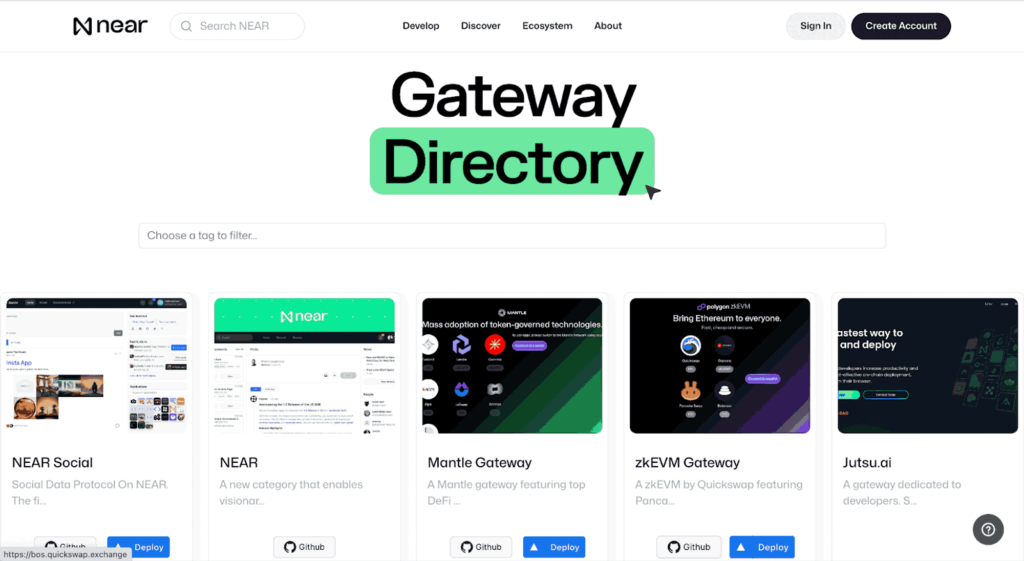
This architecture significantly reduces the friction of cross-chain interaction. Users can engage with assets on Ethereum, Solana, or NEAR through a single interface without needing to manually switch networks or manage multiple wallets. For builders, this means focusing on user experience and logic rather than the intricate details of cross-chain messaging protocols.
The result is a more cohesive Open Web experience. By abstracting the complexity of multi-chain interactions, BOS allows developers to build applications that feel native and seamless, even when they are pulling data and executing transactions from across the broader blockchain ecosystem.
NEAR BOS Crypto Market Strategy
NEAR Protocol has carved out a distinct position in the crypto market by pivoting from a general-purpose Layer-1 to an AI-native infrastructure platform. This shift is not merely a branding exercise; it reflects a strategic decision to prioritize the computational demands of decentralized AI agents and intelligent applications. By aligning its technical roadmap with the needs of AI developers, NEAR differentiates itself from competitors focused solely on financial transactions or generic smart contract functionality.
At the core of this strategy is the BOS. BOS reimagines how users interact with decentralized applications by treating front-end components as first-class citizens on the blockchain. Instead of forcing users to navigate complex, fragmented interfaces, BOS allows developers to compose and deploy secure, decentralized front-ends that are stored and executed on-chain. This approach significantly lowers the barrier to entry for Web3 experiences, making dApps feel as intuitive as traditional web applications while maintaining the security and transparency of the underlying blockchain.
The market impact of this infrastructure is becoming increasingly visible. As AI-native applications require robust, scalable, and cost-effective environments, NEAR’s technical architecture offers a compelling solution. The BOS framework enables a new class of applications that can handle complex interactions without overwhelming the user with technical overhead. This focus on usability and developer efficiency positions NEAR to capture significant market share in the growing intersection of AI and blockchain.
To understand the current market sentiment and valuation dynamics of this strategy, it is helpful to track the token’s performance alongside broader market trends.
Tools for Building on NEAR BOS
NEAR BOS isn't just a UI library; it's a complete framework for creating, testing, and deploying decentralized frontends directly on-chain. This infrastructure lowers the barrier to entry by allowing developers to treat the blockchain as a hosting environment rather than just a backend ledger. The ecosystem provides several key tools that streamline this process.
NEAR CLI
The NEAR Command Line Interface (CLI) is the primary entry point for interacting with the network. It allows developers to manage accounts, deploy contracts, and interact with BOS apps locally before pushing them to mainnet. Using the CLI, you can bootstrap new BOS projects, run local nodes for testing, and execute transactions with precise control over gas and account permissions. It serves as the bridge between your local development environment and the NEAR blockchain.
NEAR Studio
For those who prefer a browser-based experience, NEAR Studio offers a no-code to low-code interface for building BOS apps. It provides pre-built templates and a visual editor that simplifies the creation of decentralized applications without requiring extensive setup. This tool is particularly useful for rapid prototyping and for developers who want to deploy simple BOS apps quickly without managing local dependencies or complex build pipelines.
BOS SDK and Components
The BOS SDK provides the core libraries and reusable UI components that power the visual layer of NEOS apps. It includes a set of standardized widgets for displaying token balances, NFTs, and transaction history, ensuring consistency across the ecosystem. Developers can compose these components to build complex interfaces while relying on the underlying SDK to handle the heavy lifting of blockchain interaction and state management.


As an Amazon Associate, we may earn from qualifying purchases.
Ownership and Governance
NEAR Protocol was founded in 2018 by Illia Polosukhin and Alexander Skidanov, with its mainnet launching in 2020. While the founding team retains significant influence over the network's development, the protocol operates as a decentralized entity governed by its community. Understanding who controls the chain is essential for assessing its long-term viability and resistance to censorship.
The core of NEAR's governance lies in its Proof-of-Stake (PoS) consensus mechanism. Token holders can delegate their NEAR tokens to validators or run their own nodes to participate in block production. This structure distributes power across a wide network of participants rather than concentrating it in a single entity. Governance proposals are typically discussed on the NEAR Governance Forum and executed through on-chain voting, ensuring that major changes reflect the consensus of the stakeholder community.
To support this decentralized vision, NEAR introduced the BOS. As the first industry-first category of its kind, the BOS provides a common layer for browsing and discovering open web experiences compatible with any blockchain. This infrastructure shift moves the platform beyond simple token speculation, focusing instead on building a robust, accessible environment for developers and users alike. The BOS serves as the technical backbone that enables the decentralized applications to function seamlessly across the network.
This governance model balances the need for efficient development with the principles of decentralization. By empowering validators and token holders, NEAR aims to create a resilient network that can adapt to changing market conditions without relying on centralized control. The focus remains on building concrete infrastructure that supports the next generation of decentralized applications.
Common Questions About NEAR BOS
This section addresses specific queries regarding the NEAR Protocol, its native asset, and the Blockchain Operating System (BOS) to clarify their distinct roles in the ecosystem.
No comments yet. Be the first to share your thoughts!