
What is the NEAR Blockchain Operating System
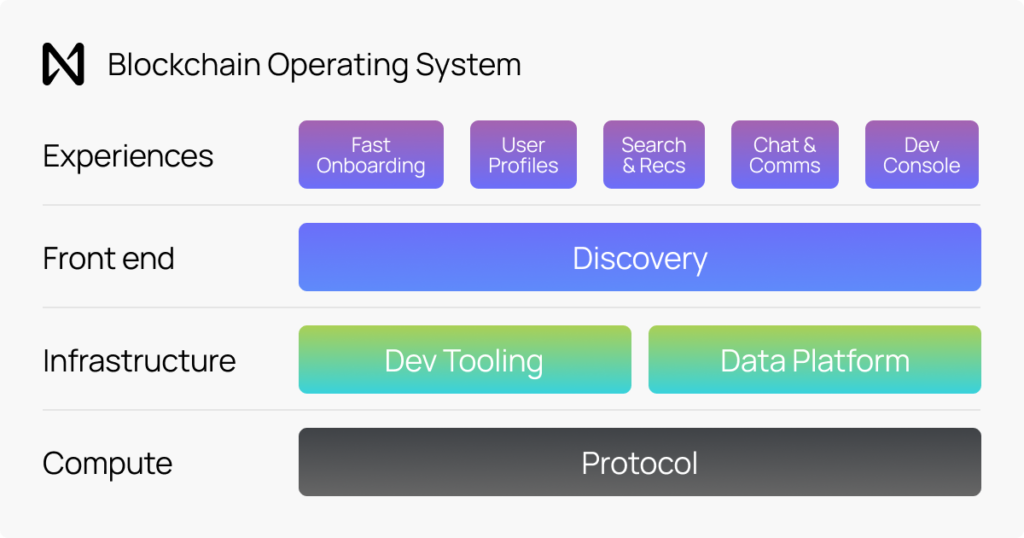
The NEAR Blockchain Operating System (BOS) is the infrastructure layer that turns NEAR Protocol into a usable platform for developers. Think of it as the bridge between raw blockchain mechanics and actual application building. Instead of wrestling with low-level consensus rules or complex sharding logic, builders use the BOS to assemble decentralized applications (dApps) with the same ease as using standard software libraries.
At its core, the BOS abstracts away the heavy lifting of blockchain infrastructure. NEAR is a fully sharded, Layer-1 blockchain designed for high throughput and low latency. It supports up to 1 million transactions per second with 600ms block times and 1.2 seconds of finality. The BOS takes this raw power and structures it into accessible tools, allowing developers to focus on user experience and logic rather than network plumbing.
This abstraction is critical for scalability. By treating blockchain resources as modular components—much like operating system services—the BOS enables seamless interaction across shards. Developers can deploy smart contracts, manage user accounts, and handle data storage without needing to manually route traffic through the underlying sharded architecture. The result is a development environment that feels familiar to traditional web developers while retaining the security and decentralization of the chain.
The official NEAR documentation emphasizes that the BOS is not just a collection of tools but a cohesive system designed to lower the barrier to entry. It provides standardized interfaces for account management, contract interaction, and data indexing. This consistency means that once a developer learns the BOS patterns, they can apply them across different dApps and use cases, accelerating the pace of innovation on the network.
The NEAR Stack: Execution and Settlement Layers
NEAR Protocol functions as a blockchain operating system by decoupling execution from settlement. This modular approach contrasts with traditional monolithic L1s, where every node must process every transaction. Instead, NEAR uses a sharded architecture that allows for parallel processing, enabling the network to handle high-throughput workloads required by AI agents and complex DeFi interactions.
At the core of this infrastructure are cross-chain execution intents. Rather than relying on slow, manual bridge transfers, NEAR’s architecture allows agents to express intent—such as "swap token A for token B on Chain X"—and have the protocol route and settle the transaction across different networks automatically. This capability is essential for building AI-native applications where agents need to own assets and transact freely without human intervention at every step. For more on how NEAR positions itself for this agent economy, visit near.org.
Settlement on NEAR is designed to be confidential and secure. By separating the execution layer (where the computation happens) from the settlement layer (where finality is recorded), the system can optimize for speed and privacy. This distinction ensures that while transactions are processed rapidly across shards, the final state is secured with robust cryptographic guarantees. This structure supports the high-frequency, low-latency requirements of modern decentralized infrastructure.

The following table compares NEAR’s modular stack against the rigid structure of monolithic L1s, highlighting why this architecture is preferred for scalable infrastructure.
| Feature | Monolithic L1 | NEAR Stack |
|---|---|---|
| Execution | Sequential, single-chain | Parallel, sharded execution |
| Cross-Chain | Manual bridges or external protocols | Native intent-based routing |
| Settlement | Tied to execution layer | Confidential, separate settlement layer |
NEAR AI and the Agent Economy Infrastructure
NEAR Protocol is positioning itself as the foundational operating system for AI agents. This isn't just about running models; it's about creating an execution layer where autonomous software can own assets, make decisions, and transact across networks without constant human oversight. The infrastructure combines cross-chain execution, confidential settlement, and private inference to solve the trust and privacy bottlenecks that currently stifle agent economies.
At the core of this architecture is the secure agent harness. Think of it as a sandboxed environment where AI agents can operate with cryptographic proof of their actions. This allows agents to hold wallets, sign transactions, and interact with decentralized applications (dApps) as independent economic actors. For developers, this means building applications where the AI component isn't just a chatbot interface but a genuine participant in the blockchain's economic graph.
The integration of private inference is critical for this model. By keeping sensitive data and model weights encrypted during computation, NEAR allows agents to process proprietary information without exposing it to the public ledger or third-party observers. This privacy-preserving capability is essential for agents handling financial data, personal health information, or competitive business strategies.
This infrastructure transforms the blockchain from a passive ledger into an active participant in the AI lifecycle. Agents can now autonomously pay for compute resources, license data, or execute smart contracts based on real-time inputs. This shift from human-mediated transactions to agent-mediated economies creates a new layer of digital utility, where value flows directly between intelligent systems.

Tools and components for builders
The NEAR BOS transforms the blockchain from a passive ledger into an active infrastructure layer. For builders, this means the frontend is no longer an afterthought but a native part of the protocol. The ecosystem provides two primary building blocks: gateways and components, which work together to create composable, full-stack applications.
NEAR Gateways
Gateways act as the entry points for your dApp. They handle authentication, data indexing, and routing, allowing developers to focus on logic rather than infrastructure plumbing. By abstracting away the complexity of node management, gateways provide a seamless interface for connecting user interfaces to the NEAR blockchain.
NEAR Components
Components are reusable, on-chain UI elements. Think of them as Lego bricks for the web. Instead of writing custom code for every wallet connection or token transfer, you import pre-built components that interact directly with smart contracts. This composable approach drastically reduces development time and ensures security best practices are baked into the UI layer.

Market Position and Ecosystem Growth
NEAR Protocol has evolved from a high-performance sharded blockchain into a dedicated infrastructure layer for AI agents. This shift is not merely branding; it restructures how the network captures value. By integrating confidential settlement and private inference, NEAR provides the secure execution environment that AI models require, positioning itself as a critical utility provider rather than just another layer-1 chain.
The revenue model reflects this infrastructure focus. As more agents operate on the network, demand for block space and computational resources increases, driving protocol fees. This creates a direct link between AI adoption and network health, moving beyond speculative token dynamics toward tangible usage metrics.
Adoption in the AI/crypto intersection is accelerating, particularly through enterprise partnerships. Collaboration with NVIDIA and inclusion in the Inception program signals that NEAR is becoming the preferred backend for secure, user-owned AI systems. This builder utility is the primary driver of its current market standing, distinguishing it from chains that lack specialized AI tooling.
The tokenomics support this growth trajectory. With a deflationary mechanism tied to transaction burns, the supply adjusts to network activity. This ensures that as the ecosystem expands and more agents transact, the economic pressure aligns with the increasing demand for infrastructure services.
Frequently Asked Questions About NEAR BOS
Understanding the technical backbone of NEAR Protocol helps clarify how it functions as a blockchain OS for AI and agent infrastructure. Here are answers to common questions about its architecture and partnerships.
The NEAR blockchain OS is designed to handle the demands of modern AI agents, offering the scalability and security required for complex decentralized applications.
Helpful gear
Use these product recommendations as a starting point, then choose the size, material, and price point that fit how you actually use the gear.


As an Amazon Associate, we may earn from qualifying purchases.
No comments yet. Be the first to share your thoughts!